In contemporary Chinese art, few images are as instantly recognisable as Yue Minjun’s — the bald head, pink skin, and wide, frozen laugh. His self-portraits, replicated in vivid colours and surreal settings, have become a defining symbol of Cynical Realism in Chinese contemporary art and a reflection of China’s shifting identity.
Yet behind the endless laughter lies something deeper. What is the Yue Minjun laughing paintings meaning? What does the symbolism behind Yue Minjun’s smile reveal about modern China — and about us?
In this article, we explore the world of the modern Chinese artist Yue Minjun, decoding the irony, humour, and humanity hidden beneath his painted grin. Through this Yue Minjun art interpretation, we’ll uncover how one man’s laughter reshaped the way we see ourselves and our society.
Origins: From Oil-Field Boy to Laughing Man
Yue Minjun was born in 1962 in the oil town of Daqing, Heilongjiang Province — a childhood surrounded by machinery, labour, and the grit of post-revolutionary China. His early years were modest, but filled with curiosity. After training in oil painting at Hebei Normal University, Yue spent the 1980s painting whenever he could while working ordinary jobs.
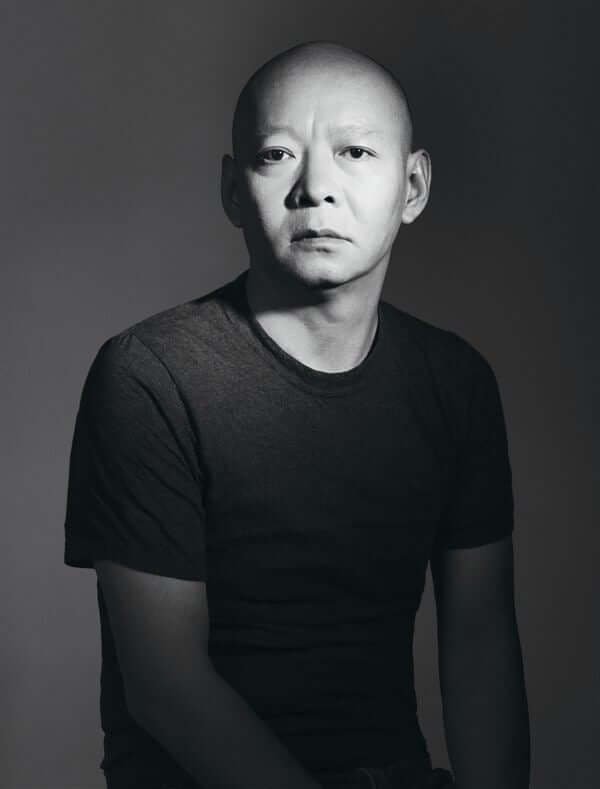
Photo: Yue Minjun.
The turning point came during the late 1980s and early 1990s — a time of artistic awakening and political turbulence. China was opening to the world, and artists were searching for a new language to express both disillusionment and hope. Yue began experimenting with self-portraits, exaggerating his own grin until it became something surreal — a performance, a persona, a mask.
He later explained, “In my work, laughter is a representation of helplessness — a reaction to the loss of strength, control, and participation society imposes on us.”
The grin, then, is not simply joy — it’s both shield and protest, a symbol of resilience. It’s what gives the symbolism behind Yue Minjun’s smile its haunting power.
The Laughing Motif: Style, Irony, and Identity
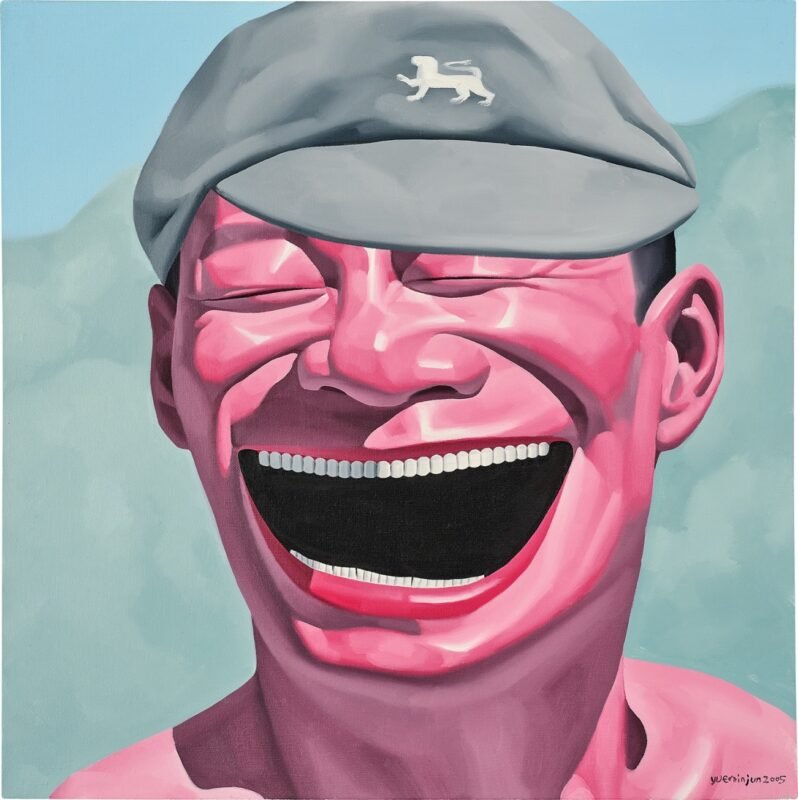
To truly understand the Yue Minjun laughing paintings meaning, we need to look at the visual language itself. His pink-skinned figures, all bearing the same laughing face, appear in surreal settings — floating, multiplied, or caught in absurd gestures. The smile is exaggerated, almost grotesque, yet magnetic. It’s impossible not to look.
Each piece oscillates between comedy and critique. The laughter feels universal yet deeply personal — the kind that can be read as joy, irony, or despair. This duality is central to Yue’s appeal: the more his figures laugh, the more we question what they’re laughing at.
Photo: Hat (2005) by Yue Minjun. Credit: Yue Minjun and Philips
According toTang Contemporary Art Gallery, Yue’s work captures “a personal mythology of laughter that reflects the contradictions of modern existence.” It’s laughter as self-defence — a mask against uncertainty.
In the broader context of Cynical Realism in Chinese contemporary art, Yue’s smile embodies the ironic detachment of a generation navigating political reform and consumer culture.
Signature Works: Execution, Massacre, and Beyond
One of Yue Minjun’s most famous works,Execution (1995), depicts a row of laughing figures in a pose reminiscent of firing squads. It’s often interpreted as a reflection on the 1989 Tiananmen Square protests, though Yue insists it’s not about a single event but about the absurdity of violence itself. The contrast between laughter and death crystallizes the tension at the heart of his art.
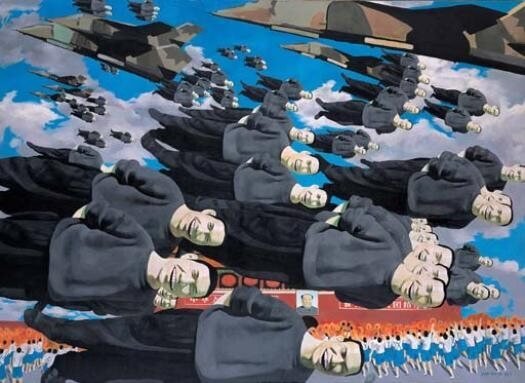
Photo: Gweong-Gweong (1993) by Yue Minjun. Credit: Yue Minjun
His other renowned pieces, such as Gweong-Gweong (1993) and Hat Series (2005), continue this dialogue between comedy and unease. At The Donum Estate in California, visitors encounter Yue’s monumental bronze sculptures — grinning figures standing in a field of vines, their laughter echoing against the landscape. Here, the Yue Minjun art interpretation shifts again: laughter becomes timeless, detached from politics yet full of emotion.
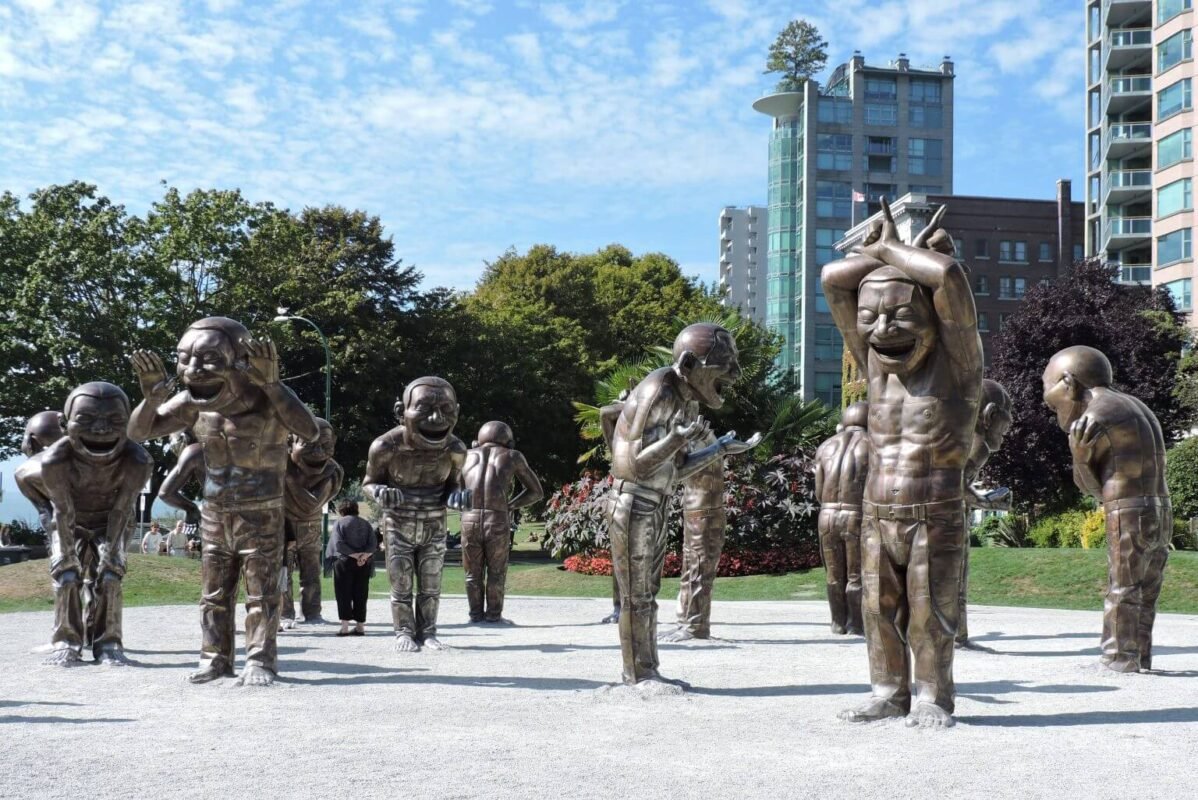
Perhaps the most iconic is A-maze-ing Laughter (2009) in Vancouver — fourteen giant bronze figures, each caught mid-laugh. Tourists can’t resist mimicking the expressions, turning art into performance. Yet as Yue has noted, “Laughter is just a starting point.” The piece invites joy, but also self-reflection: are we laughing with them, or at ourselves?
Photo: A – Maze – ing Laughter (2009) by Yue Minjun. Credit: Yue Minjun and Curated
Interpreting the Work: What Is Yue Minjun Saying?
When discussing Yue Minjun art interpretation, it’s impossible to separate the artist from his imagery. Each painting, sculpture, or print reflects fragments of his identity — a self-portrait multiplied into infinity. By using his own face as a recurring subject, Yue blurs the line between creator and creation. The repetition transforms individuality into a pattern, suggesting both conformity and self-awareness in an age defined by collective identity. His laughing figure becomes everyone and no one at the same time — a universal mask of emotion.
Yet that laughter, bright and bold on the surface, often feels uneasy underneath. Critics and writers — like those in The Laughter Behind the Painted Smile— describe it as the kind of laughter that comes from tension rather than joy. It’s humour as survival, a way to cope with alienation, rapid change, and political constraint. In this sense, Yue’s work embodies the spirit of Cynical Realism in Chinese contemporary art — ironic, self-reflective, and deeply human.
Repetition also plays a crucial role in the symbolism behind Yue Minjun’s smile. The endless duplication of his own face across paintings and public sculptures mirrors our media-saturated world, where images are shared, consumed, and repeated until meaning dissolves. But rather than resist this, Yue embraces it. His laughter becomes both a critique and a product of its time — a comment on the commodification of art itself. The modern Chinese artist Yue Minjun doesn’t just depict irony; he embodies it, standing at the intersection of sincerity and satire, individuality and mass reproduction.
Final Thoughts: The Smile That Echoes
Yue Minjun’s laughing figures are more than portraits — they are mirrors. They capture a universal human paradox: how joy and anxiety coexist. The Yue Minjun laughing paintings meaning lies in that tension — between freedom and façade, amusement and alienation.
As Yue once said, “Art is paint, experience, and story. Laughing is just the way I begin the conversation.”
So next time you see that pink-skinned grin, pause for a moment. Maybe it’s not just laughter — maybe it’s an invitation to feel, to question, and to see the world a little differently.